

After three years of volunteering for Veterinarians Without Borders Student (VWB-Student), we (Nina and I) had the opportunity to travel to Malawi to visit, among other things, the projects of Veterinarians Without Borders Netherlands (VWB-NL).
Upon arrival in Lilongwe, we were warmly welcomed by Gilbert, the project manager of VWB-NL in Malawi. He took us to Mzuzu, a city more than five hours away. During this journey, we were immediately confronted with the realities of poverty in Malawi. Scenes such as working children, houses made of clay and straw, and women carrying 10 litres of water or crops on their heads were new to us.
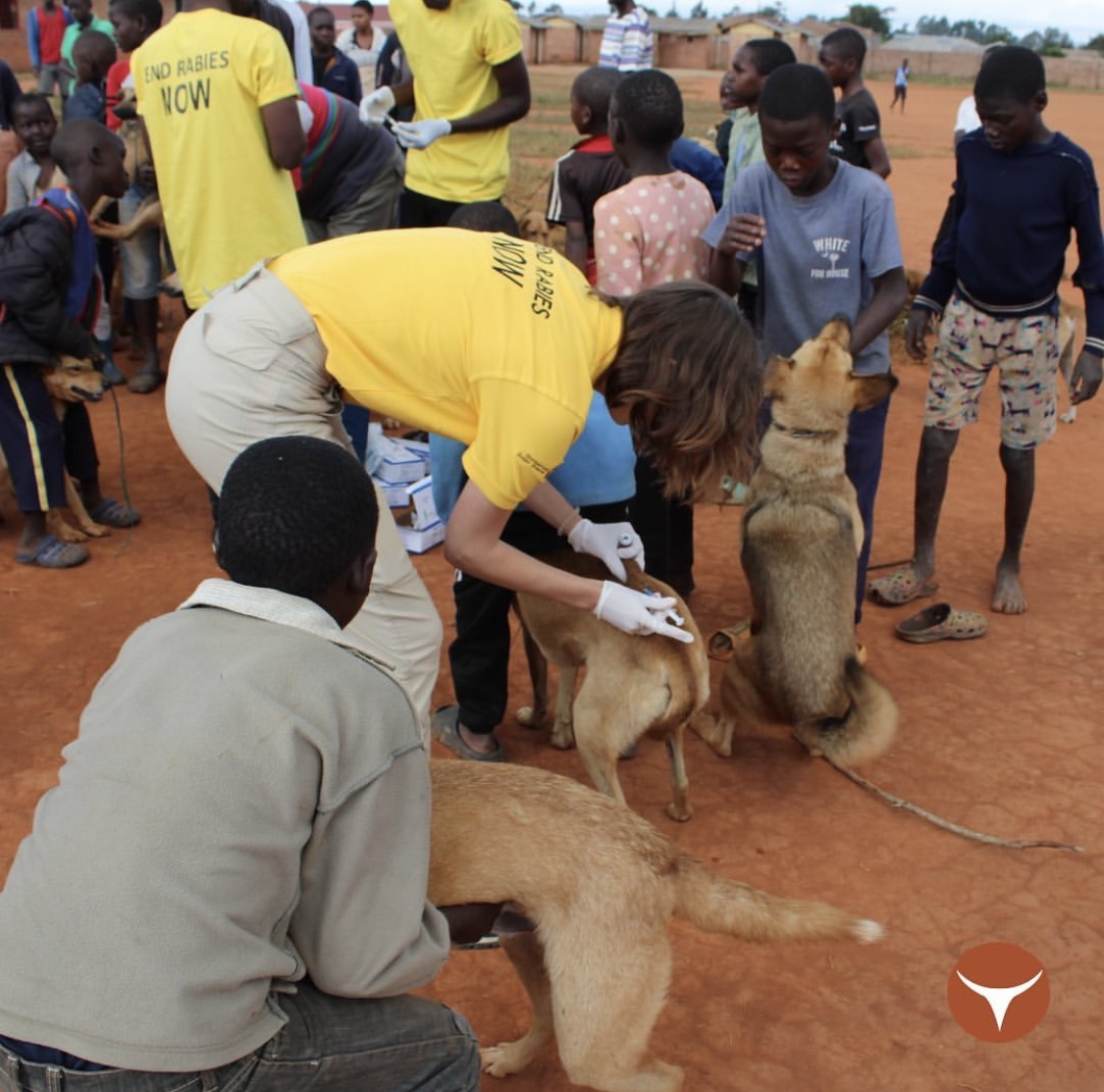
During the first week, Gilbert introduced us to daily life in the local communities. We visited several farms to inseminate cows and followed multiple Community Animal Health Workers (CAHWs), documenting their work. We also spent time at the local veterinary clinic in Mzuzu. We ended the week with a rabies vaccination campaign in Mzuzu, where we vaccinated 650 dogs in just one morning.
At 7 a.m., we arrived at the designated field — but we were certainly not the first. Over 100 people were already waiting with their dogs to have them vaccinated. We got started right away. Soon, a group of children gathered around us. They were curious about what was happening and stayed to watch throughout the morning. It was an incredible experience to carry out veterinary work while being so closely connected to the local community.
We also saw firsthand the impact of becoming a CAHW on a family’s life. One family was able to build a house twice the size of their previous home, providing enough space for all their children. They also expanded from owning 4 goats to managing as many as 50 healthy cattle. Beyond the benefits for their own family, CAHWs help entire communities keep their animals healthy. This allows farmers to maintain more productive and resilient livestock. It was incredibly meaningful to see the tangible results of our work.
For the remaining six weeks, we travelled around the country. We used local transportation as much as possible to truly experience daily life. This mainly consisted of minibuses packed with people, animal feed, tyres, and much more. We ate plenty of nsima (maize porridge) and enjoyed the local music and dance culture.
Living this way for six weeks was an incredible experience. The people in Malawi are amazing, the nature is peaceful, and there is an abundance of wildlife to spot along the way. If I ever have the opportunity to return, I would not hesitate for a second.
Amber and Nina